The whole, not the parts
Each game rewards grasping a scene's gist — its average, its flow, its balance — instead of fixating on one loud detail.
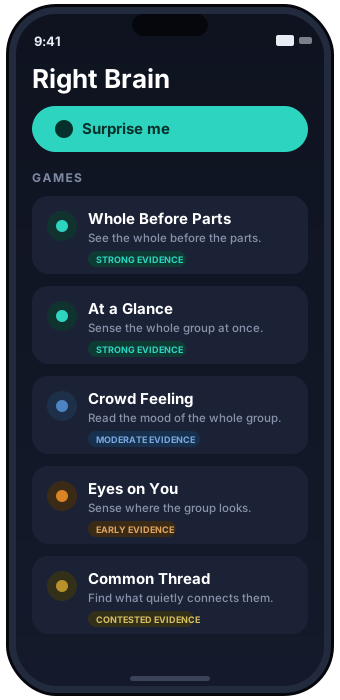
30 quick perception minigames that train the broad, open, present mode of attention — the way of seeing that grasps a whole scene at a glance, before any single detail grabs you.
iPhone · iOS 17+ · Local-only & private · No account
Let's be clear up front
You might have heard of "left-brained" and "right-brained" personalities. Brain science has retired that idea — a large 2013 study found no such whole-brain type. So Right Brain isn't "right-brain training"; it's a set of playful ways to practise the broad, open, present mode of attention.
The name is an evocative metaphor. The science is real — and we keep the two clearly apart.
A gym for the wide-angle mind
Each game rewards grasping a scene's gist — its average, its flow, its balance — instead of fixating on one loud detail.
Ensemble perception, Gestalt grouping, global motion, scene gist — every game maps to a peer-reviewed phenomenon.
Glance, sense the whole, choose. Short adaptive sessions that meet you at your level and widen your lens by the end.
See it in motion
How it works
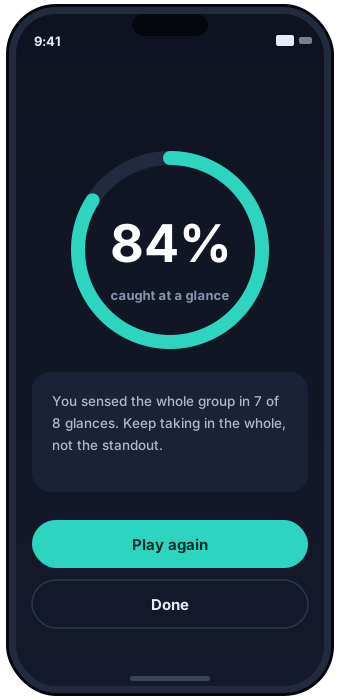
A scene appears for a brief, comfortable glance — flicker-safe by design (WCAG 2.3.1).
Sense the average, direction, balance, or pattern — the whole, not the standout.
Each round hides one salient detail built to pull your eye. Catching the whole anyway is the practice.
Difficulty tunes to your edge. Choose your pace and length in Settings — or tap Surprise me.
The catalog
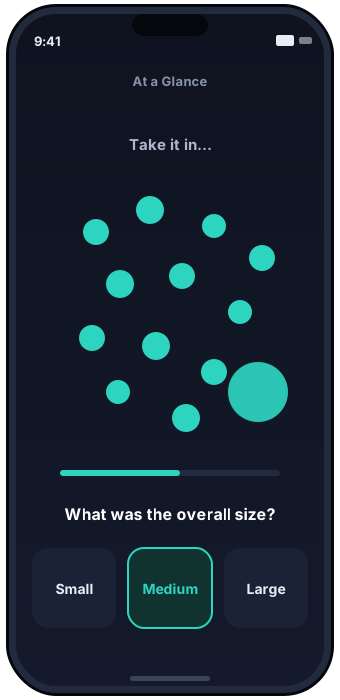
A few of the thirty — each labelled with its evidence grade.



See all 30 games & the research →
We grade by the evidence — a real mix of Strong, Moderate, Early and Contested. When the science is still debated, we say so.
Grounded in evidence
Strong, moderate, early, or contested — each game shows its grade and its peer-reviewed sources in plain sight.
We show practice consistency and how you feel before and after — concrete, measurable signals, never a single invented number.
A check in our codebase blocks medical claims and debunked neuro-myths from ever reaching a screen.
We tend to see the whole scene before its parts
Navon (1977), Cognitive Psychology
StrongWe can read the average of a group at a glance
Whitney & Yamanashi Leib (2018), Annual Review of Psychology
StrongBrain-training games make you smarter in general (a claim we don't make)
Simons et al. (2016), Psychological Science in the Public Interest
ContestediPhone, iOS 17+. Local-only and private — no account, no tracking.
Download on the App Store