
The full catalog

Thirty games. One open way of seeing.
Every one grounded in research.

Each game trains a measurable perceptual skill — taking in the whole at a glance — and carries an evidence grade tied to the peer-reviewed work behind it. The mix is deliberately varied: 8 strong · 15 moderate · 4 early · 3 contested. Where the science is still debated, we mark it contested.

Strong well-replicated · Moderate solid support · Early emerging · Contested debated

Illustration of the Whole Before Parts stimulus.
01

Whole Before Parts

Strong evidence

A large shape made of many small ones flashes by. Name the big shape, not the little ones it's built from.

Practises
Global precedence — seeing the forest before the trees.
Carry it with you
Carry a wide, big-picture read into a busy room or screen before the details pull you in.
The research
Global / holistic visual processing — the Navon global-precedence effect, in which the overall form is registered before its local parts (Navon, 1977).
Illustration of the Common Thread stimulus.
02

Common Thread

Contested evidence

A handful of everyday things share one hidden thread of meaning or use. Pick what truly belongs together — not what merely looks alike.

Practises
Relational, thematic seeing over surface labels.
Carry it with you
Notice how things connect by mood, moment, or purpose, rather than fixing on a single literal label.
The research
Thematic (relational) vs. taxonomic (feature-based) thinking (Lewis, Poeppel & Murphy, 2015); a verbal label can crowd out a holistic read (verbal overshadowing — Alogna et al., 2014). The size and reliability of these effects are still debated, so we grade it contested.
Illustration of the At a Glance stimulus.
03

At a Glance

Strong evidence

A scatter of shapes appears for a moment. Sense the group's overall size — not the one odd item out.

Practises
Ensemble perception of size.
Carry it with you
Take in the gist of a whole group at a glance instead of being captured by the standout.
The research
Ensemble perception: people rapidly and accurately extract the average size of a set, even when poor at any single item (Ariely, 2001; Chong & Treisman, 2003).
Illustration of the Crowd Feeling stimulus.
04

Crowd Feeling

Moderate evidence

A group of faces flashes up. Read the crowd's overall mood, not the single most extreme face.

Practises
Ensemble perception of emotion.
Carry it with you
Sense the feeling of a whole room rather than over-weighting one striking expression.
The research
Rapid extraction of the average emotion from a crowd of faces (Haberman & Whitney, 2007; Haberman, Harp & Whitney, 2009).
Illustration of the Which Way stimulus.
05

Which Way

Moderate evidence

A field of little lines flashes by. Sense which way it leans overall, past the one steep tilt.

Practises
Ensemble perception of orientation.
Carry it with you
Read the overall flow and tilt of a scene before any single angle grabs you.
The research
The visual system averages the orientation of many elements into a single estimate (Dakin & Watt, 1997; Parkes, Lund, Angelucci, Solomon & Morgan, 2001).
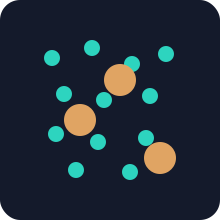
Illustration of the Center of Gravity stimulus.
06

Center of Gravity

Moderate evidence

A scatter of dots appears briefly. Sense where the whole cloud balances — not where the one big dot sits.
Practises
Ensemble perception of position (the centroid).
Carry it with you
Feel where a whole scene settles and balances before one large thing pulls your eye.
The research
People represent the centroid (average position) of a set of items at a glance, even outside the focus of attention (Alvarez & Oliva, 2008; Alvarez, 2011).
Illustration of the More or Less stimulus.
07

More or Less

Strong evidence

Two colours of dots appear mixed together. Sense which there's more of — or whether they're about the same — without counting, and without being fooled by bigger pieces.

Practises
The approximate number sense.
Carry it with you
Estimate and compare quantities at a glance instead of stopping to count.
The research
Beyond a few items, people estimate and compare numerosity rapidly and without counting; this approximate number sense is well established (Halberda, Mazzocco & Feigenson, 2008; Dehaene, The Number Sense, 2011).
Illustration of the Side by Side stimulus.
08

Side by Side

Moderate evidence

A grid of dots flashes up. Let the whole pattern settle — rows, columns, or diagonals — and don't let one bright streak pull you another way.

Practises
Gestalt grouping by proximity.
Carry it with you
Let a whole field organise itself for you instead of effortfully searching it.
The research
Grouping by proximity: nearer elements organise into rows, columns, or diagonals (Wertheimer, 1923; Kubovy & Wagemans, 1995, dot lattices).
Illustration of the Common Fate stimulus.
09

Common Fate

Strong evidence

A field of dots drifts for a moment; most move together while a few dart off. Sense the overall flow.
Practises
Global motion integration (common fate).
Carry it with you
Take in where a whole scene is moving rather than chasing the few fast standouts.
The research
The visual system integrates many local motions into one global direction (Wertheimer, 1923, common fate; Newsome & Paré, 1988, motion-coherence).
Illustration of the Mirror stimulus.
10

Mirror

Moderate evidence

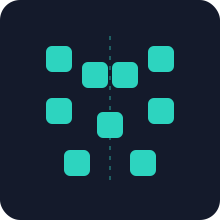
A pattern flashes up. Read its whole balance — mirrored left–right, top–bottom, or not at all.

Practises
Holistic symmetry perception.
Carry it with you
Register the overall shape and balance of a space before any single detail leads you.
The research
Bilateral (mirror) symmetry is detected rapidly and holistically (Wagemans, 1997; Bertamini, Silvanto, Norcia, Makin & Wagemans, 2018).
Illustration of the True Colors stimulus.
11

True Colors

Moderate evidence

A scatter of coloured dots appears. Sense the group's overall colour, not the one odd shade.

Practises
Ensemble perception of colour.
Carry it with you
Read the overall palette of a scene before one bright spot draws you.
The research
People rapidly extract the average hue of a set of colours (Maule & Franklin, 2016; Webster, Kay & Webster, 2014).
Illustration of the Overall Glow stimulus.
12

Overall Glow

Moderate evidence

A field of dots flashes, some dim and some bright. Sense the overall brightness.

Practises
Ensemble perception of brightness.
Carry it with you
Take in the overall light of a space before one glowing point grabs you.
The research
People average the brightness of a set of items at a glance (Bauer, 2009).
Illustration of the Average Length stimulus.
13

Average Length

Strong evidence

A set of lines flashes by, some short and some long. Sense the overall length.

Practises
Ensemble perception of length.
Carry it with you
Read the overall scale of things at once instead of fixing on the one long line.
The research
The average length of a set is extracted rapidly and accurately even when single items are not (Ariely, 2001; Chong & Treisman, 2003).
Illustration of the Sharp or Soft stimulus.
14

Sharp or Soft

Moderate evidence

A field of patches flashes, some crisp and some soft. Sense its overall focus.

Practises
Coarse-to-fine (global-first) processing.
Carry it with you
Settle into a soft, whole-field read before any one sharp detail pulls you in.
The research
The visual system reads the low-detail global gist first, before fine detail (Schyns & Oliva, 1994; Hughes et al., 1996).
Illustration of the Join the Dots stimulus.
15

Join the Dots

Moderate evidence

A ring of dots sketches a shape without drawing it. Let the whole shape come together.

Practises
Gestalt closure.
Carry it with you
Let whole shapes and forms assemble themselves before you trace any single edge.
The research
The visual system completes a whole figure from incomplete contours (Wertheimer, 1923; Kanizsa, 1979).
Illustration of the Swirl stimulus.
16

Swirl

Moderate evidence

A cloud of paired dots flashes up. Together they swirl, burst, or stream — sense the whole pattern's flow.

Practises
Global form integration (Glass patterns).
Carry it with you
See the overall pattern emerge without inspecting a single pair.
The research
Paired dots (Glass patterns) are pooled into a whole percept — concentric, radial, or translational (Glass, 1969; Wilson & Wilkinson, 1998).
Illustration of the Who Goes There stimulus.
17

Who Goes There

Strong evidence

A handful of moving dots traces a figure in motion. Sense which way it's heading.

Practises
Biological-motion perception.
Carry it with you
Read a whole moving figure and its direction without tracking any single point.
The research
A few point-lights are integrated into a vivid whole figure and its motion (Johansson, 1973; Blake & Shiffrar, 2007).
Illustration of the Set the Pace stimulus.
18

Set the Pace

Moderate evidence

A field of dots drifts, some quick and some slow. Sense its overall pace.

Practises
Ensemble perception of speed.
Carry it with you
Take in how fast a whole field is moving rather than chasing the fastest mover.
The research
People average the speed of many moving items at a glance (Watamaniuk & Duchon, 1992).
Illustration of the The Far Side stimulus.
19

The Far Side

Contested evidence

Keep a soft central gaze; a mark flashes out toward the edges. Sense where it appeared.

Practises
A wide, useful field of view.
Carry it with you
Spread your awareness to the edges of vision rather than tunnelling on the centre.
The research
The useful field of view can widen with practice, though how far the benefits transfer to everyday tasks is debated (Ball & Owsley, 1993; Green & Bavelier, 2003).
Illustration of the First Glance stimulus.
20

First Glance

Strong evidence

A scene flashes for a heartbeat. Sense what kind of place it is — don't hunt for objects.

Practises
Rapid scene-gist perception.
Carry it with you
Grasp the whole character of a place before naming a single thing in it.
The research
The overall meaning of a scene is grasped within a single glance, before objects are identified (Potter, 1976; Greene & Oliva, 2009).
Illustration of the Eyes on You stimulus.
21

Eyes on You

Early evidence

A group of eyes glances different ways. Sense where, on the whole, they're looking.

Practises
Ensemble perception of gaze.
Carry it with you
Sense a group's shared direction of attention without studying one face.
The research
Viewers can extract the average gaze direction of a crowd, though this is a newer, still-developing finding (Sweeny & Whitney, 2014).
Illustration of the How Many stimulus.
22

How Many

Moderate evidence

A burst of dots flashes — far too many to count in time. Let a rough number land.

Practises
Numerosity estimation.
Carry it with you
Let an approximate quantity arrive without counting one by one.
The research
Beyond about four items, people estimate quantity approximately rather than counting (Kaufman et al., 1949; Dehaene, The Number Sense, 2011).
Illustration of the Birds of a Feather stimulus.
23

Birds of a Feather

Moderate evidence

A grid of two kinds of marks flashes up. Let likeness pull them into rows, columns, or diagonals.

Practises
Gestalt grouping by similarity.
Carry it with you
Let similar things fall into groups on their own before you single any out.
The research
Like elements organise into a whole pattern (Wertheimer, 1923, grouping by similarity).
Illustration of the Follow the Line stimulus.
24

Follow the Line

Strong evidence

A winding path of aligned marks hides in a field of random ones. Let the whole contour pop out, and sense which way it bends.

Practises
Contour integration (good continuation).
Carry it with you
Let a whole path emerge from noise rather than tracing it mark by mark.
The research
Aligned elements are linked into a whole path by good continuation (Field, Hayes & Hess, 1993; Wertheimer, 1923).
Illustration of the Light from Above stimulus.
25

Light from Above

Moderate evidence

A field of shaded bumps and dimples flashes up. Read the whole at once — popping out, or pressed in?

Practises
Shape-from-shading.
Carry it with you
Read a whole field's depth and light before one odd shading misleads you.
The research
The visual system reads depth from shading, assuming light comes from above (Ramachandran, 1988; Kleffner & Ramachandran, 1992).
Illustration of the Same Family stimulus.
26

Same Family

Early evidence

A scatter of shapes flashes, some round and some spiky. Sense the group's overall character.

Practises
Ensemble perception of shape.
Carry it with you
Read the overall character of a group of shapes without studying one odd form.
The research
Averaging shape across a set extends ensemble coding to form; it is a newer, still-developing line of research (Haberman & Whitney, 2012, review).
Illustration of the Tall or Wide stimulus.
27

Tall or Wide

Early evidence

A scatter of rectangles flashes, some tall and some wide. Sense the group's overall proportion.

Practises
Ensemble perception of aspect ratio.
Carry it with you
Sense the overall proportions of a space rather than fixing on one extreme.
The research
Averaging aspect ratio extends ensemble coding to shape proportion; a newer, still-developing finding (Haberman & Whitney, 2012, review).
Illustration of the Over Time stimulus.
28

Over Time

Early evidence

A single shape pulses, changing size moment to moment. Sense the average of the whole stream.

Practises
Temporal ensemble perception.
Carry it with you
Sense the overall feel of a stream over time rather than latching onto the latest moment.
The research
People can average a feature over a sequence presented across time; a newer, still-developing finding (Albrecht & Scholl, 2010).
Illustration of the Connected stimulus.
29

Connected

Moderate evidence

A grid of dots flashes up, some joined by faint links. Let the links group the field — rows, columns, or diagonals.

Practises
Gestalt grouping by connectedness.
Carry it with you
Follow how things are quietly connected before you single any one out.
The research
A connecting line is a powerful grouping cue, often overriding proximity (Palmer & Rock, 1994, uniform connectedness).
Illustration of the Don't Crowd Me stimulus.
30

Don't Crowd Me

Contested evidence

A shape flashes off to the side, hemmed in by clutter. Keep a soft central gaze and read which way it points.

Practises
Reading the gist amid flankers (crowding).
Carry it with you
Keep an open, steady span of attention so a shape stays readable amid clutter.
The research
Clutter impairs recognition of a peripheral target (crowding); how much practice reduces it, and how far that transfers, is actively studied (Bouma, 1970; Whitney & Levi, 2011).

Now on the App Store.

iPhone, iOS 17+. Local-only and private — no account, no tracking.

Download on the App Store